 blog
blog
Book Botox Consultation Bellaire TX: 2026 Guide
Table of Contents
- Why Booking a Botox Consultation in Bellaire Matters
- What to Ask at a Botox Consultation
- Botox Unit Pricing Explained: Why Flat-Rate Changes the Conversation
- How to Prepare for a Botox Consultation
- Safety, Side Effects, and Medical History Screening
- Beyond Wrinkles: Botox for Jaw Tension and Excessive Sweating
- Combining Botox with Fillers and Other Treatments
- What to Expect After Your Appointment: A 14-Day Recovery Timeline
- Frequently Asked Questions
Last Updated: September 30, 2026
Why Booking a Botox Consultation in Bellaire Matters
Booking a Botox consultation is the step that separates a good result from a regretful one. A consultation is a clinical assessment, not a sales pitch. It is where a licensed provider reviews your medical history, maps your facial anatomy, and decides how much neuromodulator your muscles actually need. At Get Tox'd, every first visit starts here, because dosing by face beats dosing by formula.
Most people search for a provider, compare prices, and book the cheapest option. That order is backwards.
The consultation is where you learn whether a provider is qualified, whether their pricing is honest, and whether their plan fits your goals. Skip it, or treat it as a formality, and you hand control of your face to someone you never vetted.
A proper session covers four things: your goals, your medical history, a facial assessment, and a written treatment plan with costs. If a provider skips any of these, walk away.
The sections below walk through exactly what to ask, how unit pricing works, how to prepare, and what the first two weeks look like.
What to Ask at a Botox Consultation
Ask about credentials, dosing logic, and touch-up policy before anyone picks up a syringe. Those three answers tell you more than any before-and-after photo. A provider who welcomes the questions is usually the one worth booking.
Bring a short list and work through it out loud. The best providers answer without defensiveness.
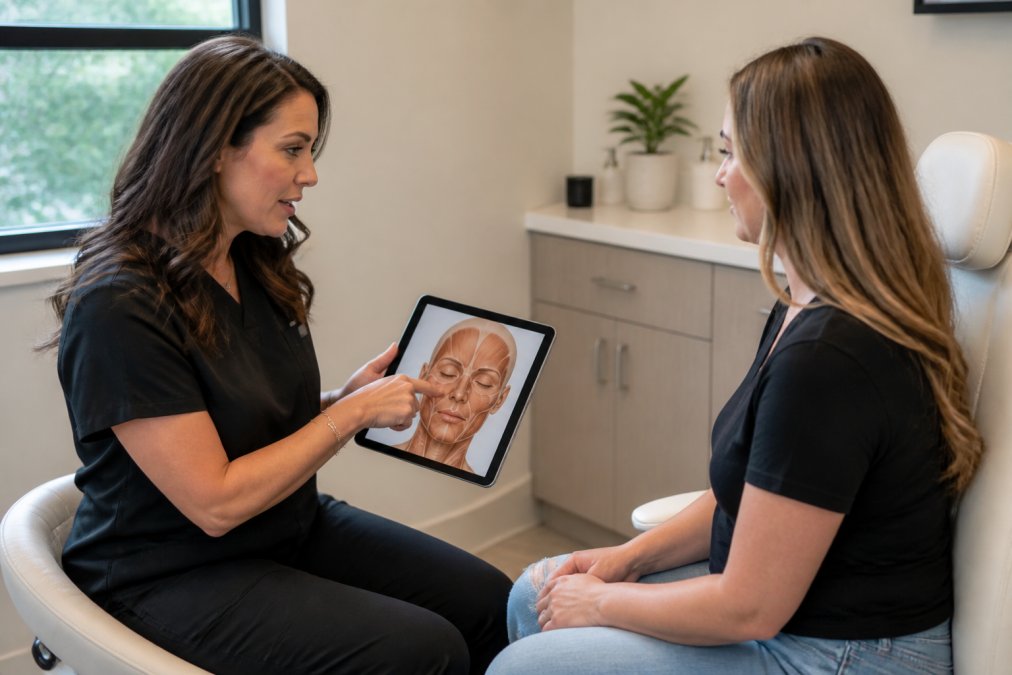
Questions About Provider Credentials and Safety
The first question is who is actually holding the syringe. In medical aesthetics, that person should be a licensed medical professional with specific training in facial injectables. Ask directly: what is your license, who supervises the practice, and how many injections have you performed?
Credentials to look for include:
- An active medical or nursing license in the state
- Documented training in facial anatomy and neuromodulator injection
- A supervising physician or medical director named on request
- A clean record with the state medical board
Get Tox'd, for example, staffs licensed medical professionals, including providers board-certified in Anatomic and Clinical Pathology, licensed in 43 states, with more than 15 years in the aesthetics industry. That kind of detail is what you are listening for. Vague answers about "years of experience" without a license number are a red flag.
Questions About Dosing, Results, and Touch-Ups
The second set of questions covers how the provider decides your dose and what happens if you dislike the result. Ask what product they plan to use, how many units they expect, and which muscles they will treat. A provider who can explain the plan in plain language understands it.
Then ask about touch-ups. Most clinics charge again for a correction visit. Some include it. Get Tox'd includes free touch-ups with main treatments, which matters if this is your first time and you are nervous about the outcome.
Finally, ask what "natural-looking" means to them. You want muscle relaxation, not a frozen forehead. A provider who talks about softening dynamic wrinkles while preserving expression is thinking about your face, not a template.
Botox Unit Pricing Explained: Why Flat-Rate Changes the Conversation
Botox unit pricing is the single biggest source of surprise bills in medical aesthetics. Most clinics charge per unit, and most faces need more units than the initial quote suggests. The math is simple: more units, higher cost, and you often do not learn the real number until you are in the chair.
Here is how the two models compare.
| Pricing Model | How It Works | What You Risk | Best For |
|---|---|---|---|
| Per-unit | Charged for each unit injected | Final cost depends on dose needed | Patients who know their exact dose history |
| Per-area flat rate | One price per treatment area | None from dose changes | First-timers and anyone wanting a fixed bill |
| Membership | Recurring fee covers scheduled treatments | Commitment if you skip visits | People on a maintenance schedule |
A flat rate removes the incentive to underdose. When a clinic charges per unit, there is pressure to quote low to win the booking and dose higher once you are on the table. When the price is set by area, the provider can dose to your anatomy, not to a budget.
That is the model Get Tox'd built its practice around: one price per area, unlimited units included, no hidden fees. For anyone who has been burned by a quote that doubled at checkout, the difference is not cosmetic. It is the whole point.
Book now your FREE consultation →
Ask any provider, flat-rate or not, to put the full cost in writing before treatment. If they will not, that is your answer.
How to Prepare for a Botox Consultation
Preparing for a Botox consultation takes about ten minutes and saves you a wasted appointment. The goal is to arrive with a clear history, honest goals, and realistic expectations. Providers can only work with what you tell them.
Do these five things before you go:
- Write down every medication and supplement you take, including over-the-counter ones
- Note any history of neuromuscular or bleeding disorders
- Skip alcohol for 24 hours before your visit to reduce bruising risk
- Bring a list of past cosmetic treatments and when you had them
- Decide your goal: soften lines, prevent new ones, or treat jaw tension or sweating
Come with a clean face if you can. Makeup does not prevent treatment, but a bare face helps the provider see your muscle movement clearly during the clinical assessment.
One more tip: schedule your consultation at least two weeks before any event. If you book treatment the same day, you want that buffer for the product to settle and any touch-up to happen.
Safety, Side Effects, and Medical History Screening
Safety in Botox treatment starts with the medical history screening, not the injection. Neuromodulators are well studied, but they are not right for everyone. An honest provider screens you out if you are a poor candidate, even though it costs them a sale.
Common side effects are mild and short-lived: small bruises at the injection site, a mild headache, or temporary heaviness in the treated area. These usually resolve within days. Rare complications include eyelid drooping, which is why dosing precision and provider skill matter.
- Pregnancy or breastfeeding
- A history of neuromuscular disorders such as myasthenia gravis
- Current use of blood thinners or certain antibiotics
- Prior allergic reactions to botulinum toxin products
- Active infection at a planned injection site
Contraindications and Medications to Disclose
Contraindications are conditions that make treatment unsafe or inadvisable. Some are absolute, meaning you should not be treated. Others are relative, meaning the provider weighs risk against benefit. The only way to know which applies to you is a full disclosure during the consultation.
Beyond Wrinkles: Botox for Jaw Tension and Excessive Sweating
Botox treats more than forehead wrinkles. Two medical uses have grown fast: masseter injections for jaw tension and injections for excessive sweating, known as hyperhidrosis. Both are legitimate clinical applications, not cosmetic add-ons.
Combining Botox with Fillers and Other Treatments
Combining Botox with dermal fillers is common and often gives better results than either alone. The two products do different jobs. Neuromodulators relax the muscles that create dynamic wrinkles. Fillers restore volume lost to aging. Used together, they address both movement and structure.
A few combinations worth discussing at your consultation:
- Botox plus fillers: Softens expression lines while restoring cheek or lip volume
- Botox plus microneedling: Relaxes muscles while improving skin texture, usually spaced a week or two apart
- Botox plus skincare: Supports a broader anti-aging plan without adding downtime
What to Expect After Your Appointment: A 14-Day Recovery Timeline
Recovery from Botox is minimal, but the results are not instant. Full effect takes up to 14 days as the neuromodulator binds to nerve endings and muscle relaxation sets in. Knowing the timeline prevents the panic that hits people on day three when nothing looks different yet.
Here is what most patients experience:
| Day | What You'll Notice |
|---|---|
| Day 1 | Tiny bumps at injection sites fade within hours; mild redness possible |
| Days 2-3 | No visible change yet; this is normal, not a failed treatment |
| Days 4-7 | Early softening of dynamic wrinkles begins |
| Days 8-14 | Full effect; this is the window for a free touch-up if needed |
| Week 3+ | Results hold; plan your next visit for around the 3-4 month mark |
Frequently Asked Questions
What should I expect during a Botox consultation?
A typical Botox consultation includes a clinical assessment of your facial anatomy, a review of your medical history and goals, and a personalized treatment plan. The provider will discuss which areas to treat, how many units are needed, and what results to expect. At Get Tox'd, consultations are free, and flat-rate pricing means the quoted price covers unlimited units for your treatment area.
How do I know if a Botox provider is qualified?
Look for licensed medical professionals with specific aesthetic training and experience. Ask about their credentials, how many injections they perform regularly, and whether they have complication protocols in place. Get Tox'd providers are licensed medical professionals, board-certified in Anatomic and Clinical Pathology, and licensed in 43 states with over 15 years of aesthetics experience.
How does flat-rate Botox pricing work compared to per-unit pricing?
Per-unit pricing means you pay for each unit of neuromodulator used, so your final cost depends on how many units your provider determines you need. Flat-rate pricing, like Get Tox'd offers, charges one price per treatment area with unlimited units included. This removes the guesswork and prevents surprise charges if your provider needs more units than initially estimated.
Can Botox help with jaw tension or excessive sweating?
Yes. Botox is FDA-approved for severe underarm sweating (hyperhidrosis) and is commonly used off-label for jaw tension and TMJ-related discomfort. These treatments use the same neuromodulator but target different muscles or glands. At Get Tox'd, these medical treatments are available at the same flat rate as cosmetic Botox, with dosing customized to your needs.