
 How-to
How Does Flat Rate Botox Work? Pricing Explained
Table of Contents
- What Is Flat Rate Botox and How Does It Work?
- Botox Cost Per Unit vs Flat Rate: A Side-by-Side Comparison
- Average Units of Botox for Forehead, Glabellar Lines, and Crow's Feet
- How to Avoid Unit Anxiety with Botox: What to Ask Before You Commit
- The Over-Treatment Risk: Why Unlimited Units Still Require Injector Judgment
- Touch-Up Policies and What They Actually Cover
- Conclusion
- Frequently Asked Questions
Last Updated: October 3, 2026
What Is Flat Rate Botox and How Does It Work?
Flat rate Botox is a pricing model where you pay one set price for a treatment area, no matter how many units of neurotoxin you need.
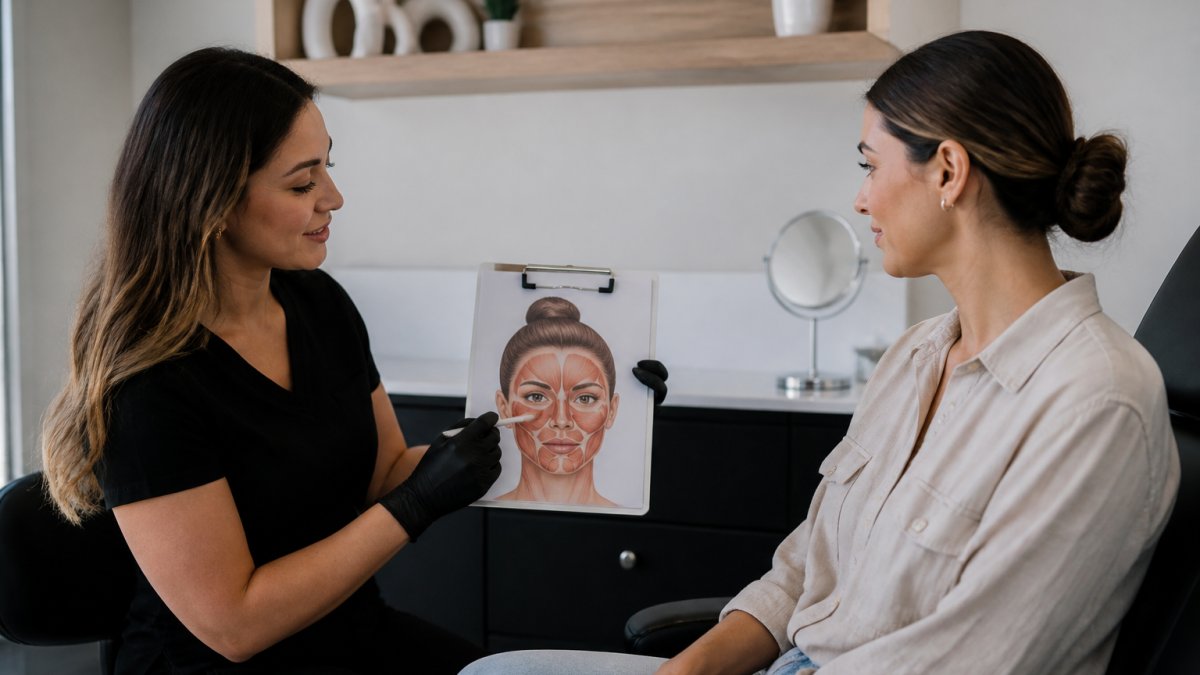
Here's how it works. A licensed medical provider looks at your facial anatomy, your muscle activity, and your aesthetic goals. Then they decide how many units you actually need.
That's the short version. The longer version matters more than most people realize.
Flat Rate vs. Per-Unit Pricing: The Core Difference
Per-unit pricing means you pay for each unit of Botox injected. If your treatment needs more units than expected, your bill goes up. Flat-rate pricing means the treatment area sets the price, not the unit count.
That single difference changes how you experience the whole appointment. With per-unit pricing, you might find yourself doing math mid-consultation. With a flat rate, you can focus on the result instead of the receipt.
Most med spas still use the per-unit model. It's not inherently bad, but it does shift risk onto you. If your muscles are strong or your lines are deep, you pay more.
Botox Cost Per Unit vs Flat Rate: A Side-by-Side Comparison
The two models differ in more ways than just the final number. Here's how they stack up:
| Factor | Per-Unit Pricing | Flat Rate Pricing |
|---|---|---|
| Cost basis | Number of units used | Treatment area |
| Price certainty | Unknown until dosing | Known upfront |
| Higher-dose areas | Costs more | Same price |
| Touch-ups | Often charged again | Free with main treatment |
| Best for | Light dosing, small areas | Full-face or multi-area treatment |
The biggest practical gap is predictability. With per-unit pricing, a forehead treatment might need anywhere from a modest dose to a heavier one depending on your muscle strength. You won't know which until the provider assesses you.
Flat rate removes that variable. You're paying for the outcome, not the dose.
If you want to see how this plays out in real numbers, American Society of Plastic Surgeons procedural statistics tracks national trends in cosmetic injectable use, which helps explain why pricing models keep evolving.
Average Units of Botox for Forehead, Glabellar Lines, and Crow's Feet
Dosing ranges are not trade secrets. Most experienced injectors work within familiar bands, then adjust up or down based on what they see in your face. Here is how those bands typically break down for the three most common upper-face areas:
| Treatment Area | Muscle Treated | Typical Unit Range | Why It Varies |
|---|---|---|---|
| Glabellar lines (the "11s") | Corrugator supercilii and procerus | Roughly 20-30 units | Deep, strong frown muscles need more; smaller faces need less |
| Forehead lines | Frontalis | Roughly 10-20 units | The frontalis is a broad, flat muscle, so dosing is spread across the brow |
| Crow's feet | Orbicularis oculi | Roughly 12-24 units total (both sides) | The muscle rings the eye, so units are split across several injection points |
A full upper-face treatment, glabella, forehead, and crow's feet together, commonly lands somewhere in the 40-64 unit range for a first-time patient. Men often need more because facial muscle mass tends to be greater. People who have been treated regularly for years often need less, because the muscle has been trained to relax.
Why the Number Moves
The exact dose depends on four things:
- Muscle strength. A muscle that contracts hard needs more neurotoxin to quiet down.
- Wrinkle depth. Dynamic lines that have been etched in for years may need a higher dose to soften visibly.
- Treatment goal. Softening is a lower dose than full smoothing.
- Treatment history. First-timers usually need more than maintenance patients.
This is exactly where per-unit pricing gets stressful. A provider might quote you based on an average, then find your anatomy needs 15 more units than expected. Under flat rate Botox, that adjustment doesn't change your bill.
The Unit-to-Price Conversion: Is Your Flat Rate Actually a Deal?
Here is the angle most guides skip. A flat rate is only a good deal if the price is competitive with what you would pay per unit for your specific anatomy. You can estimate that yourself before you book.
- Estimate your likely unit count using the ranges above. If you have strong muscles or deep lines, assume the high end.
- Find the per-unit price at a few local providers. Per-unit pricing for botulinum toxin products can vary depending on market and provider type.
- Multiply units by per-unit price to get your estimated per-unit total.
- Compare that total to the flat rate. If the flat rate is lower than your high-end estimate, it is a strong deal for you. If it is higher than your low-end estimate, you may be subsidizing patients who need more units than you do.
That last point matters. Flat-rate pricing pools risk across patients. If your anatomy needs fewer units than average, you may pay more than you would under per-unit pricing. If your anatomy needs more, you win. Knowing which side of the average you fall on is the whole game.
How to Avoid Unit Anxiety with Botox: What to Ask Before You Commit
Unit anxiety is the low-grade worry that your final bill won't match the quote. It's common, and it's fixable. Ask these questions before you book anywhere:
- Is the price per unit or per area?
- What happens if I need more units than estimated?
- Are touch-ups included, and how long do I have to use them?
- Who performs the injection, and what are their credentials?
- Can I see a full price list before my appointment?
A provider who answers these clearly is a provider worth trusting. One who dodges them usually isn't.
Book now your FREE consultation →
At Get Tox'd, our pricing is based on treatment area, not units, so the quote you get is the price you pay. We also include free touch-ups with main treatments, which takes the guesswork out of follow-up visits.
The Over-Treatment Risk: Why Unlimited Units Still Require Injector Judgment
Unlimited units sounds great until you think about what could go wrong. More neurotoxin isn't automatically better. Over-treating the forehead can drop the brow. Over-treating around the eyes can flatten expression.
That's why injector expertise matters more under a flat-rate model, not less. When units are unlimited, the provider has to be disciplined about when to stop.
What most guides miss is this: the flat-rate model works only when the injector treats your face, not a template. At Get Tox'd, our providers are licensed medical professionals, and our dosing is customized for male and female facial anatomy. That's the safeguard against over-treatment.
Touch-Up Policies and What They Actually Cover
Touch-up policies are where flat-rate pricing gets murky, and most guides gloss over it. The fine print decides whether your "free touch-up" is a real safety net or a marketing line. Here is how to read a policy like a skeptic.
The Four Terms That Define a Fair Policy
A genuine touch-up policy answers four questions without hedging:
- The window. How many days after your main treatment can you request a touch-up? A fair window is usually two to four weeks, long enough for the neurotoxin to fully settle, short enough that the result is still adjustable.
- The dose. Is the touch-up dose included in full, or capped at a small number of units? "Free touch-up" that only covers 2-4 units is not the same as a touch-up that covers whatever the provider needs to finish the job.
- The appointment fee. Some providers waive the product cost but charge an office visit fee. That is not free.
- The number of visits. One touch-up is standard. Unlimited touch-ups within the window is generous but rare.
What a Fair Policy Looks Like Under Flat Rate
Under a flat-rate model, the provider has already been paid for the treatment area. A fair touch-up policy should reflect that. The strongest version covers the full adjustment dose and the visit, within a defined window, with no per-unit cap. Anything less is a partial policy dressed up as a full one.
A common pattern is a two-week touch-up window with the dose included and no visit fee. If a provider offers less than that, ask why. The answer tells you how confident they are in their own dosing.
Red Flags to Watch For
- A touch-up window shorter than 10 days, before the neurotoxin has fully taken effect
- A dose cap that would not meaningfully change your result
- A visit fee that turns "free" into a paid appointment
- A policy that requires you to leave a review or post on social media to qualify
- Verbal promises with nothing in writing
Why This Matters More Under Flat Rate
Under per-unit pricing, a touch-up is a straightforward transaction: you pay for more units. Under flat rate, the touch-up is the provider's cost. That is a good thing for you, it aligns their incentive with getting the dose right the first time. But it also means the policy is the only thing standing between you and a second full-price treatment if the first one under-delivers.
Get the policy in writing before you book. A provider who will not put it in writing is telling you something.
U.S. Food and Drug Administration information on botulinum toxin products outlines how these products are approved and labeled, which is useful context when you are comparing provider claims about what a touch-up can and cannot accomplish.
Conclusion
Flat rate Botox works by shifting the pricing question from "how many units?" to "which area?" That one change removes most of the anxiety people bring to their first appointment. The catch is that it only works well when the injector has the judgment to dose properly, not just generously.
If you're tired of surprise costs and unit math, Get Tox'd offers flat-rate pricing by treatment area, unlimited units, free touch-ups with main treatments, and dosing by licensed medical providers. We also treat jaw tension and excessive sweating under the same transparent model.
Frequently Asked Questions
What is the difference between flat rate and per-unit Botox pricing?
Per-unit pricing charges you for every unit of neurotoxin injected, so your final bill depends on how many units your provider determines you need. Flat rate Botox charges one set price per treatment area, regardless of how many units are used. With per-unit pricing, a forehead treatment might use 10 units for one patient and 25 for another, and the cost scales accordingly. Flat rate removes that variable entirely, so you know the cost before you sit in the chair.
Does flat rate Botox include unlimited units for any treatment area?
At practices that offer flat rate Botox, the price typically covers as many units as your injector determines are appropriate for the treated area. That said, unlimited units does not mean unlimited areas. Most flat rate models price per area, so treating your forehead, glabellar lines, and crow's feet would each carry their own flat fee. Ask specifically which areas are included at the quoted price and whether add-on areas cost extra.
How do medical providers determine dosage in a flat rate model?
Dosage is still based on your individual anatomy, muscle activity, and aesthetic goals. A provider assesses how your muscles move when you make expressions like frowning or squinting, then maps injection points accordingly. Male patients often need more units than female patients because of greater muscle mass in the forehead and glabellar region. The flat rate does not change the clinical protocol; it only changes how the cost is calculated.
What happens if I need a touch-up with flat rate Botox?
Touch-up policies vary by provider, so ask before you book. Some flat rate practices include one complimentary touch-up within a set window, usually two to four weeks after your initial treatment, to refine areas where the neurotoxin did not fully settle. Others charge a separate fee. Get the policy in writing and confirm the timeframe, because a touch-up requested after the window closes is typically treated as a new appointment.