 how-to
Botox Touch-Up Policy Explained: What to Expect
Table of Contents
- Understanding Your Botox Touch-Up Policy Before Treatment
- How Long After Botox Can You Get a Touch-Up
- What Happens at Your Botox Follow-Up Appointment
- Handling Uneven Botox Results and Corrections
- Botox Touch-Up Cost: What You Should Know
- Safety and When to Contact Your Provider
- Frequently Asked Questions
Last Updated: October 7, 2026
Understanding Your Botox Touch-Up Policy Before Treatment
A botox touch-up policy is your provider's written agreement about what happens if your results don't meet expectations after your initial treatment. Before you book, you need to understand exactly what's covered.
Most people skip this step. They focus on the injector's skill or the price per unit. Then they're surprised when a follow-up appointment costs money or comes with strings attached.
Get Tox'd makes this simple. Our flat-rate pricing includes free touch-ups on your treatment area. No unit anxiety. No surprise bills.
What policies typically cover
Get Tox’d offers a 10-21 day touch-up window after your initial treatment. This gives your provider time to assess your results and determine whether any adjustments are needed. Touch-ups within this window are complimentary for the originally treated area. After 21 days, additional treatment may be subject to a charge.
What's included varies:
- Symmetry corrections, fixing uneven results between the left and right side of your face
- Strength adjustments, adding or reducing units if the effect is too strong or too weak
- Coverage gaps, treating areas you feel were missed
- Dose refinement, tweaking the placement or amount for natural-looking results
What policies commonly exclude
Not everything is free. Policies often exclude:
- Treatments outside the assessment window, if you wait more than 21 days after your initial treatment, any additional treatment may be subject to a charge.
- New treatment areas, adding forehead lines when you originally treated only your crow's feet typically costs extra
- Results from user error, if you massage the area or exercise too soon and move the product, that's on you
- Dissatisfaction with natural results, if your face just looks like your face, that's not a "problem" to fix for free
- Frequent touch-ups beyond the standard schedule, some clinics limit complimentary adjustments to once per treatment cycle
Ask your provider: What's the exact cutoff date? Are there unit limits? Do adjustments to a different area cost extra?
How Long After Botox Can You Get a Touch-Up
You can contact your provider with questions at any time, but Get Tox’d uses a 10-21 day window for touch-up assessments. This gives your provider enough time to evaluate how your treatment has settled and determine whether an adjustment is needed.
The 10-21 day assessment window
Botulinum toxin does not work instantly. Results develop over several days, which is why Get Tox’d allows a 10-21 day window for touch-up assessments. During this time, your provider can evaluate your results and determine whether additional units are appropriate for the originally treated area.
If you notice something you would like your provider to assess, reach out during the 10-21 day window. Touch-ups during this window are complimentary for the originally treated area.
Why timing matters for safe adjustments
Injecting botulinum toxin twice in quick succession carries risk. Overdosing is possible.
If you wait until after the 21-day touch-up window, additional treatment may be subject to a charge. At that point, the visit falls outside the complimentary touch-up period and may be treated as a new treatment rather than a touch-up.
If you're unhappy with your results before day 10, contact your provider anyway. They may be willing to assess early.
What Happens at Your Botox Follow-Up Appointment
At Get Tox’d, touch-up assessments are available within 10-21 days of your initial treatment. If an adjustment is needed for the originally treated area during this window, the touch-up is complimentary.
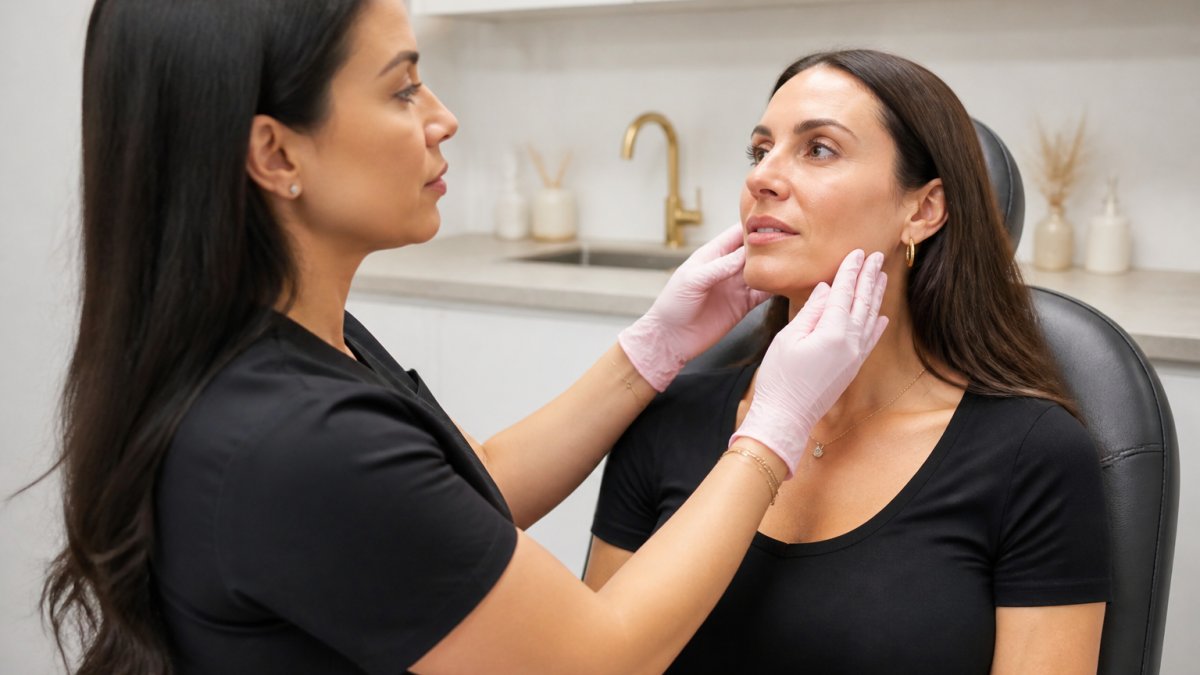
How clinics assess results and decide on adjustments
Your injector will ask you to move your face through a standard set of expressions. Raise your eyebrows. Frown hard. Squint. Smile wide. Puff your cheeks.
They will compare your left and right sides at rest and in motion.
If asymmetry exists, they will work through the likely cause before reaching for the syringe:
- Anatomical asymmetry, one side of your face naturally has more muscle mass or a higher resting brow. This is common and often needs a slightly different dose per side from the start.
- Placement variance, an injection landed a millimeter off and treated a neighboring muscle. This shows up as a localized patch of movement rather than a whole-side difference.
- Metabolism differences, one side breaks down the toxin faster. This tends to appear later in the cycle rather than at the two-week mark.
- Dose imbalance, the units were split unevenly between sides. This is the easiest to correct and the most common reason a touch-up is offered.
Once your injector identifies the cause, they check your policy. Can they add units to the weaker side? Can they refine placement? Is this adjustment included, or does it cost extra?
How to document concerns and prepare for your follow-up
Arriving with organized notes shortens the visit and produces a better adjustment. A simple protocol works well:
- Log the treatment date and exact areas treated. Note the product name, the number of units per area, and the injector's name. If your clinic does not give you this in writing, ask for it.
- Take consistent photos. Use the same lighting, the same distance, and the same neutral expression each time. Shoot at rest and at maximum animation (raised brows, hard frown, full smile). Take them at day 0, day 7, and day 14 so you can see the trend rather than a single moment.
- Note functional concerns, not just cosmetic ones. "My right brow does not lift when I raise my eyebrows" is more useful than "it looks uneven." "I cannot fully close my left eye" is a safety concern, not a cosmetic one, and should be reported immediately.
- Write down what you expected versus what you see. Bring the note. Specific feedback helps your provider make precise adjustments.
- List your questions in advance. Ask about the assessment window, whether the touch-up is included, and what the plan is if the adjustment does not fully resolve the concern.
If your injector seems dismissive of your concerns, that is a red flag. A good provider listens, explains their reasoning, and shows you what they are seeing. They do not pressure you into accepting results you are unhappy with.
Questions to ask before you book
A short list of questions before your first appointment prevents most touch-up disputes later: (Source: American Society of Plastic Surgeons' 2026 statistics)
- What is the exact window for a complimentary touch-up?
- Is the follow-up visit itself included, or is there a separate consultation fee?
- Are touch-up units complimentary, capped, or charged at the per-unit rate?
- Does the policy cover only the originally treated area, or can it extend to a new area?
- What happens if I miss the window because of travel or illness?
- Who performs the touch-up, the original injector or whoever is available?
- Is the policy in writing, and can I get a copy before I pay?
Get Tox’d makes this simple. Our flat-rate pricing includes complimentary touch-ups for the originally treated area when assessed within our 10-21 day touch-up window. After 21 days, additional treatment may be subject to a charge.
Handling Uneven Botox Results and Corrections
Uneven results are common. They're not always a sign of a bad injector. Sometimes it's your anatomy. Sometimes it's how your body metabolizes the botulinum toxin. The fix depends on the cause.
Common causes of asymmetry
Your face isn't perfectly symmetrical to begin with. One eyebrow may sit higher. One side of your forehead may have deeper lines.
Book now your FREE consultation →
Botox works on muscle. If your right side has more muscle mass, it needs more units to relax fully.
Placement matters too. The injection site has to be precise. A millimeter off changes which muscle gets treated.
Some people metabolize botulinum toxin faster on one side. This is rare but real.
What your provider can and cannot fix
Your injector can add units to the weaker side. They can adjust placement. They can refine the dose based on your anatomy and how your body responds.
What they can't do: reshape your face or change your underlying bone structure. Botox relaxes muscle. It doesn't add volume or change contours.
They also can't guarantee perfect symmetry. Your face isn't symmetrical.
Botox Touch-Up Cost: What You Should Know
Touch-up pricing varies wildly. Some clinics include them free. Others charge per unit. Some offer a limited number of complimentary units, then charge for the rest. Understanding the model before you commit matters.
Complimentary units versus charged adjustments
Get Tox’d uses flat-rate pricing, so you pay one price for your treatment area rather than worrying about a per-unit charge. If your provider determines that a touch-up is needed within the 10-21 day window, the adjustment is complimentary for the originally treated area. After 21 days, additional treatment may be subject to a charge.
Per-unit clinics charge differently. Your initial treatment might cost a set amount and each additional unit will be charged.
Read your contract. Ask: Are touch-ups included in the base price? If not, what's the per-unit cost?
How to compare pricing fairly across providers
Don't compare based on unit cost alone. Compare the total cost of your treatment plus any likely touch-ups.
If Clinic A charges $200 for 20 units and Clinic B charges $400 flat-rate with unlimited units, which is cheaper?
Ask each provider: What's the total I'll pay if I need a 10% touch-up? What if I need 20%?
Also ask about membership options. Some studios offer discounts on future treatments if you prepay or commit to regular visits.
Safety and When to Contact Your Provider
Most botox touch-up appointments are routine. But some symptoms need prompt medical attention. Know the difference between normal and concerning.
Normal side effects include mild swelling, redness, or bruising at injection sites. These fade in hours to days.
Contact your provider immediately if you experience:
- Severe swelling or bruising that worsens after 24 hours
- Difficulty swallowing or speaking
- Drooping eyelids or facial weakness beyond the treated area
- Allergic reaction signs: hives, itching, difficulty breathing
- Headache or flu-like symptoms that start within hours of injection
- Facial asymmetry that feels severe or is getting worse, not better
These symptoms are rare but possible. They require evaluation by a qualified medical professional, not a text message to your injector.
If you're unsure, call. A good provider answers safety questions immediately.
Choosing the right provider means understanding their botox touch-up policy before you commit. Ask about the Tox'd Club for membership savings on ongoing treatments.
Frequently Asked Questions
How long after Botox can you get a touch-up?
Get Tox’d offers a 10-21 day window for touch-up assessments after your initial treatment. This gives your provider time to evaluate your results and determine whether an adjustment is needed. Touch-ups for the originally treated area are complimentary when addressed within this window. After 21 days, additional treatment may be subject to a charge. If you have concerns about your results, contact Get Tox’d so your provider can determine the best next step.
What's usually included in a Botox follow-up appointment?
A follow-up appointment typically includes a visual assessment of your results, discussion of any concerns about symmetry or muscle response, and evaluation of whether additional units are needed in specific treatment areas. Your injector will examine your facial expression at rest and during movement. Many providers include complimentary touch-up units as part of the initial treatment, though the number and eligibility may vary by policy. Confirm what's included before your first injection.
What should I do if my Botox results look uneven?
Document your concerns with photos taken in consistent lighting at rest and during facial movement. Bring these to your follow-up appointment and discuss them clearly with your injector. Uneven results can stem from asymmetrical muscle strength, injection placement, or individual response to the dose. Your provider may recommend additional units in specific areas or a refinement injection. Most clinics address asymmetry during the standard follow-up window without extra charges if it's part of their touch-up policy.
Does a Botox touch-up cost extra?
At Get Tox’d, touch-ups for the originally treated area are complimentary when assessed within our 10-21 day touch-up window. Our flat-rate pricing means you don't have to worry about paying per unit for your initial treatment. If additional treatment is needed after the 21-day touch-up window, it may be subject to a charge.